Platform · Audit-ready valuations
Valuations, done. Audit, ready.
GoodStream collects and validates every input from your documents, calculates and allocates the marks by your policy, and writes the assessment behind each one. Quarter-end becomes a review, not a reconstruction.
Built with the fund finance teams at our design-partner funds, the people who used to build this by hand.
The quarter, in four steps
We collect, calculate and document. You approve.
Set your valuation policy once: ASC 820 or IFRS 13, the IPEV guidelines, your pricing window, your ladder. Every quarter after that, GoodStream collects and validates the support, calculates and allocates the marks the way your policy says to, writes the assessment behind each one, and assembles the audit file as it goes. For the material positions, the policy asks for the full capital structure, so you can see how it would waterfall at an exit and assess the value of your shares; GoodStream has that structure, rights and preferences included, off the legal documents. Your team reviews and approves.

01 Get ready
We collect and validate
Every position is checked for the support a mark needs: the investment documents, the cap table, the financial package. What is missing is listed and chased.
02 Set your marks
We calculate and allocate, by your policy
A mark and methodology for every position, applied the way your policy says, with the reason and the documents behind it, and the judgment calls held for you.
03 Assessment
We document, to your policy
A written assessment behind every mark, as long as the event deserves and no longer, drafted from your documents and cited to the page.
04 Approve
You review and publish
Preparer and approver separated, every exception named, and the valuation of record published with a visible trail. A published mark can be restated, never silently changed.
Set your marks
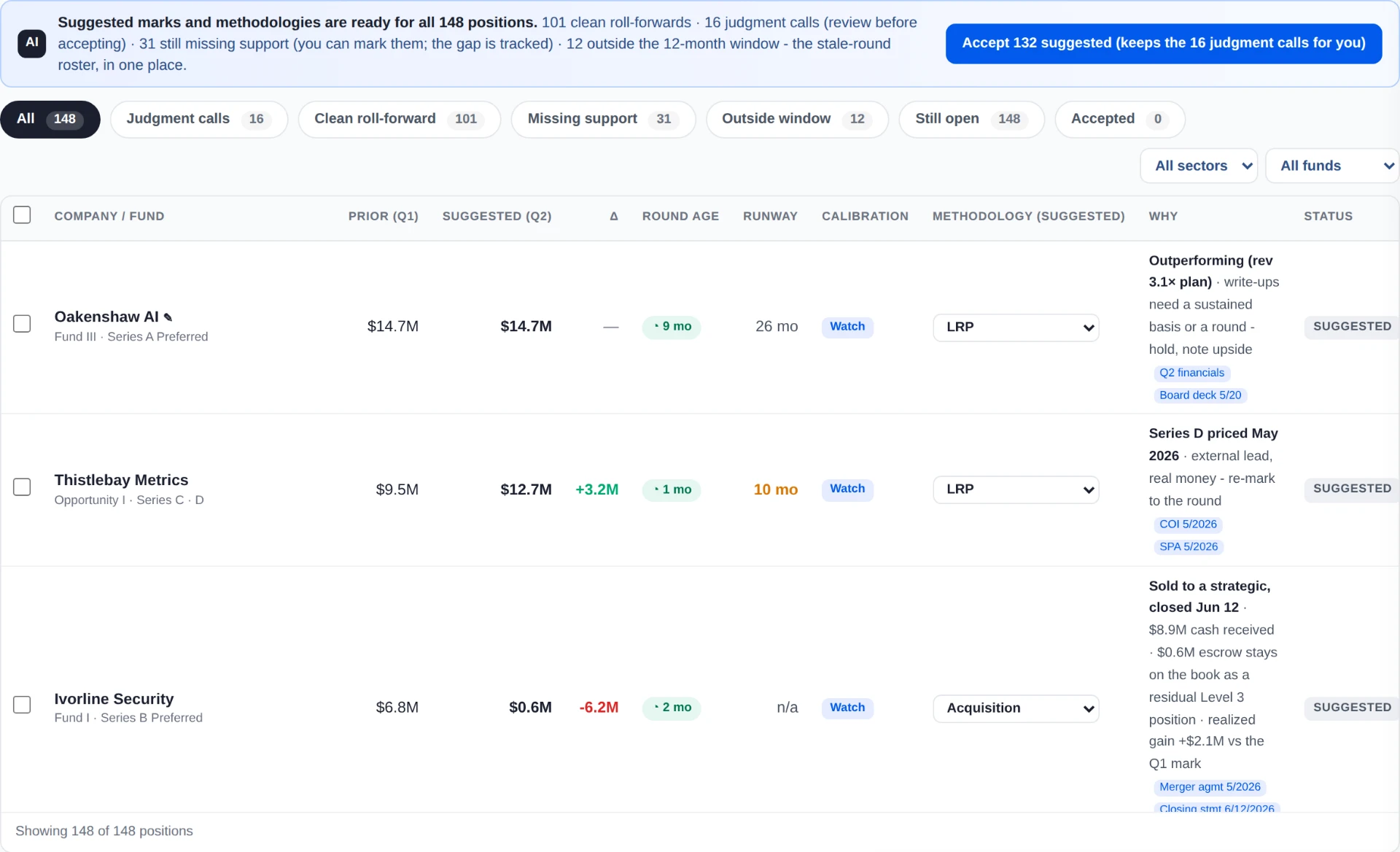
A suggested mark for every position, and the reason.
GoodStream processes the financials and investment documents for every company and sets the mark and the methodology your policy calls for: last round price, calibration, an adjustment off your ladder, or a specialist path. Every mark carries the reason and the documents behind it. Clean roll-forwards are accepted in one click, judgment calls are held for you, and the positions outside your pricing window sit in one roster instead of a hunt through the book. The model work that starts with digging through charters for preferences and dividend rates is already set up, for every company, which is what lets you value a larger part of the portfolio the same way.
Assessment
A documented assessment behind every mark, written to your policy.
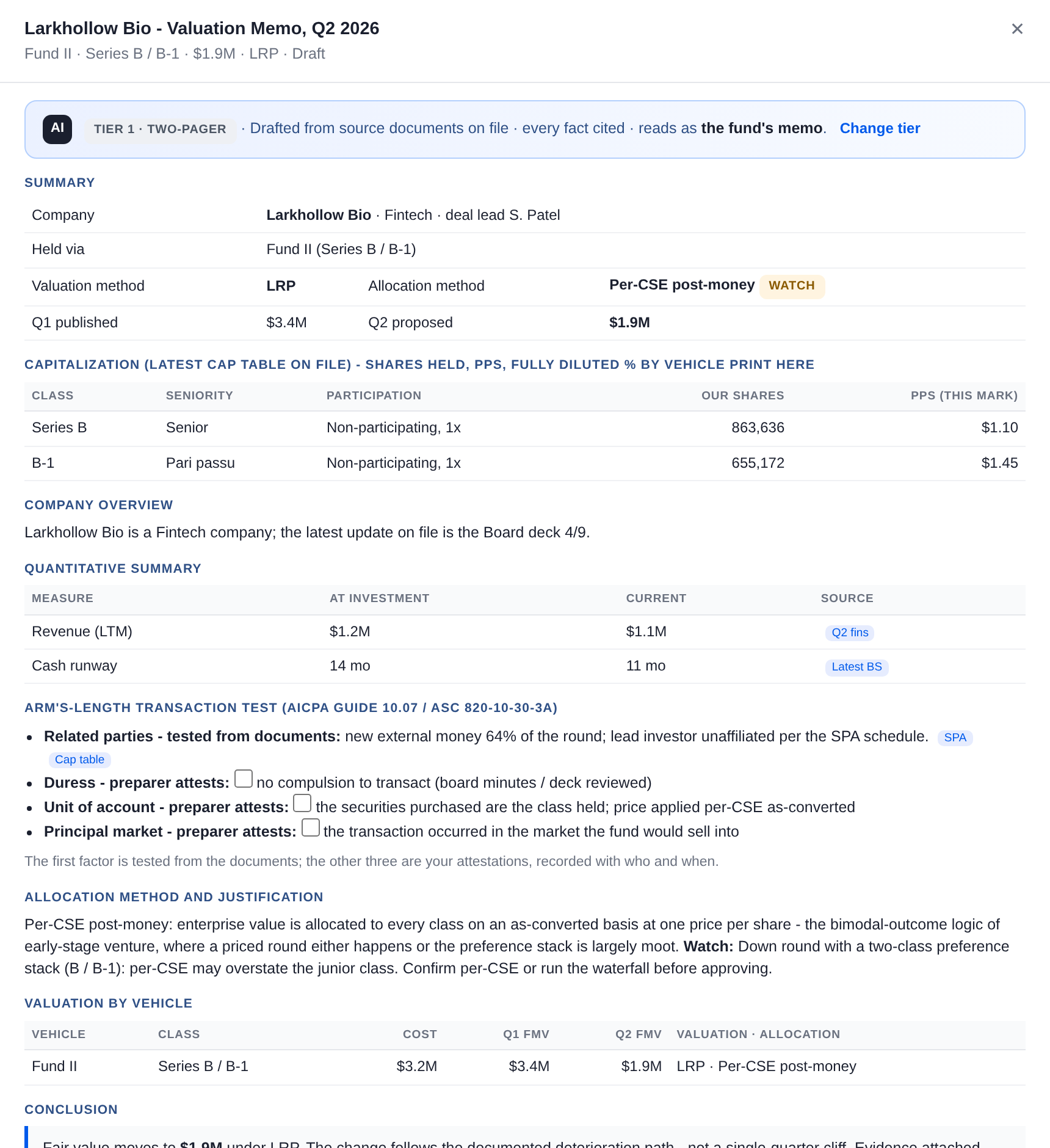
Every mark gets the write-up an auditor expects, sized to what happened. A clean hold gets a commentary paragraph in the valuation summary. A new round, an event, or a stale hold gets the two-pager: the cap table with seniority and participation, the event, the allocation method, the per-vehicle table. A specialist or adjustment mark gets the full memo. Drafted from your documents and your policy, cited to the page, and accepted or edited by your preparer before anything is approved. This is the memo for a down round, as drafted: read it and decide whether you would put your name under it.
The sections auditors read first. Arm's-length testing on new rounds, and developments since the round on stale holds.
Two methods, both stated. How enterprise value was set, and how it was allocated across the classes. The headline may say a billion; you hold seed and common, and your mark is what your shares are worth.
Provenance on every memo. Who accepted it, when, and which prompt version drafted it.
The bridge
From last quarter's number to this one.
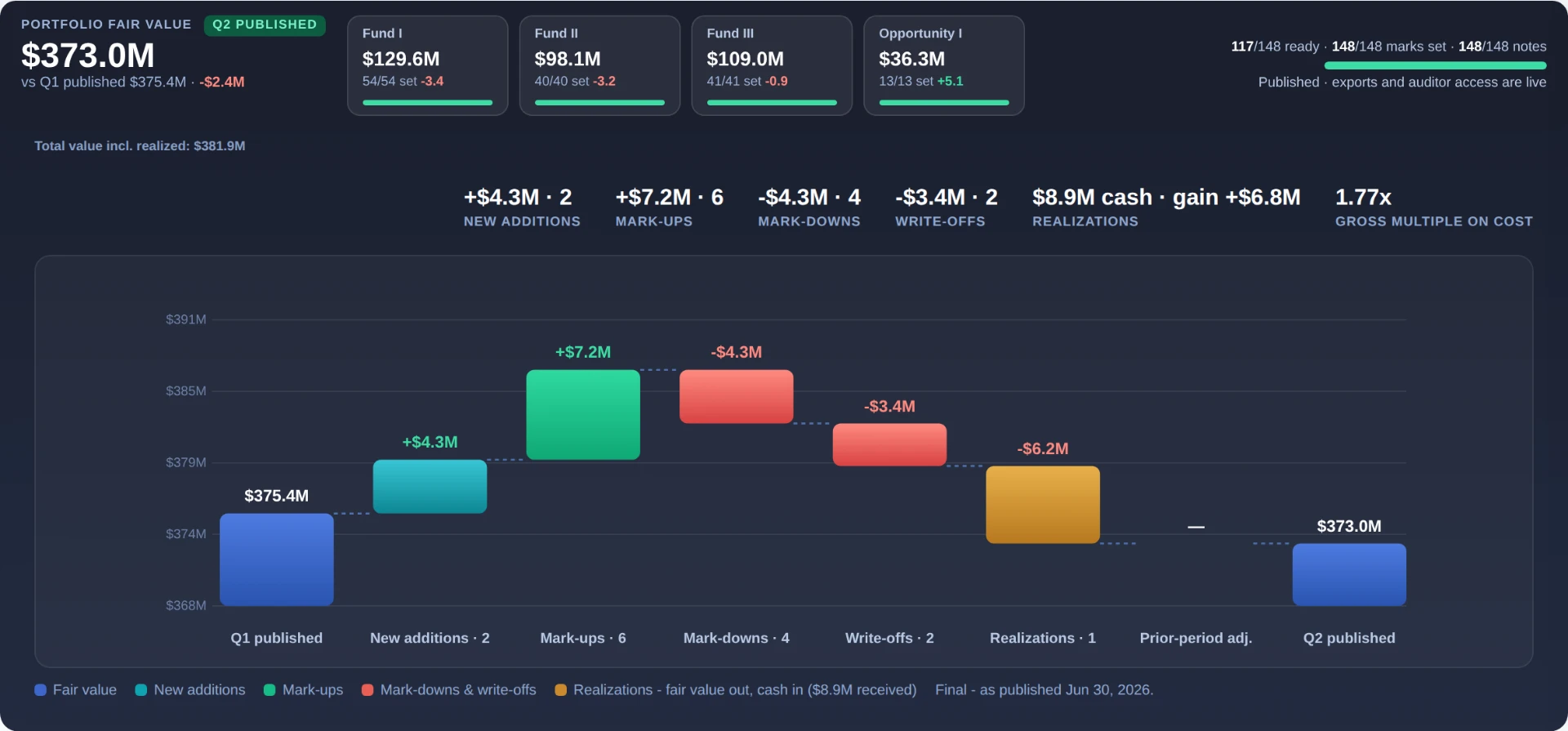
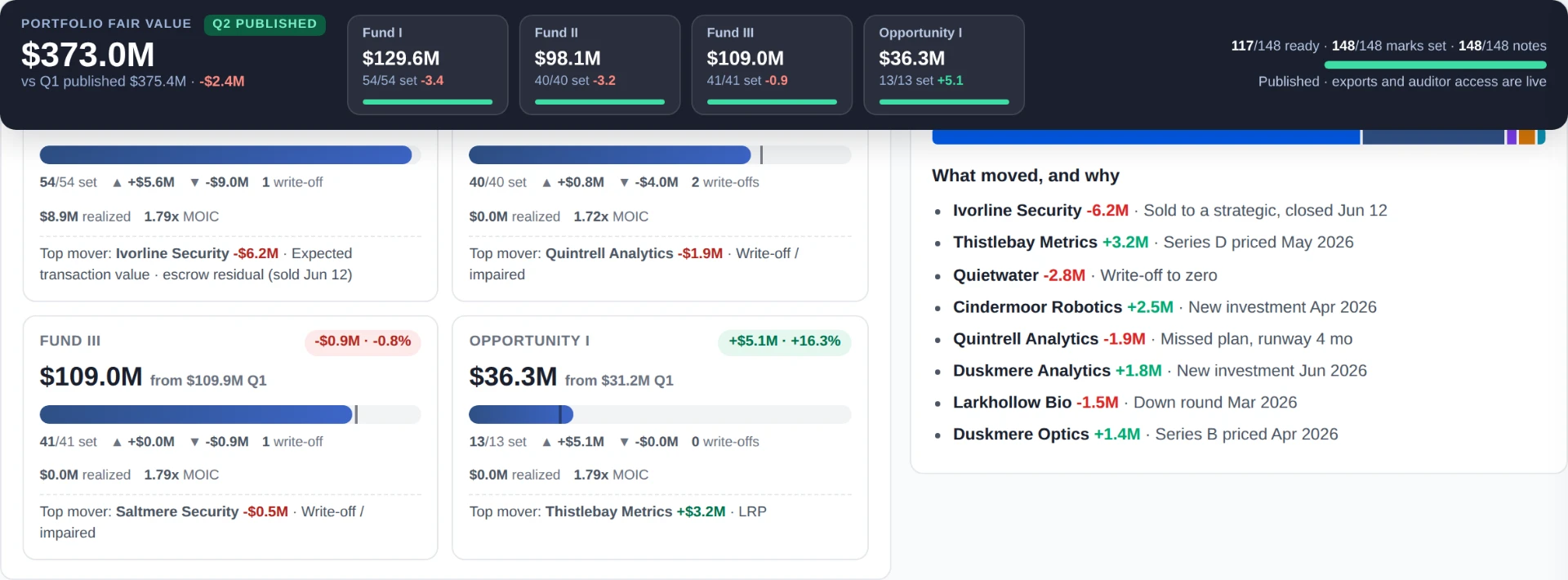
Published value last quarter, new investments, mark-ups, mark-downs, write-offs, realizations, published value this quarter, by fund and for the whole book. The same bridge in the auditor's own layout is the Level 3 fair-value rollforward, and it is one sheet in the audit pack. What moved, and why, is listed under it with the document behind each move.
Approve
Your policy, applied before anyone signs.
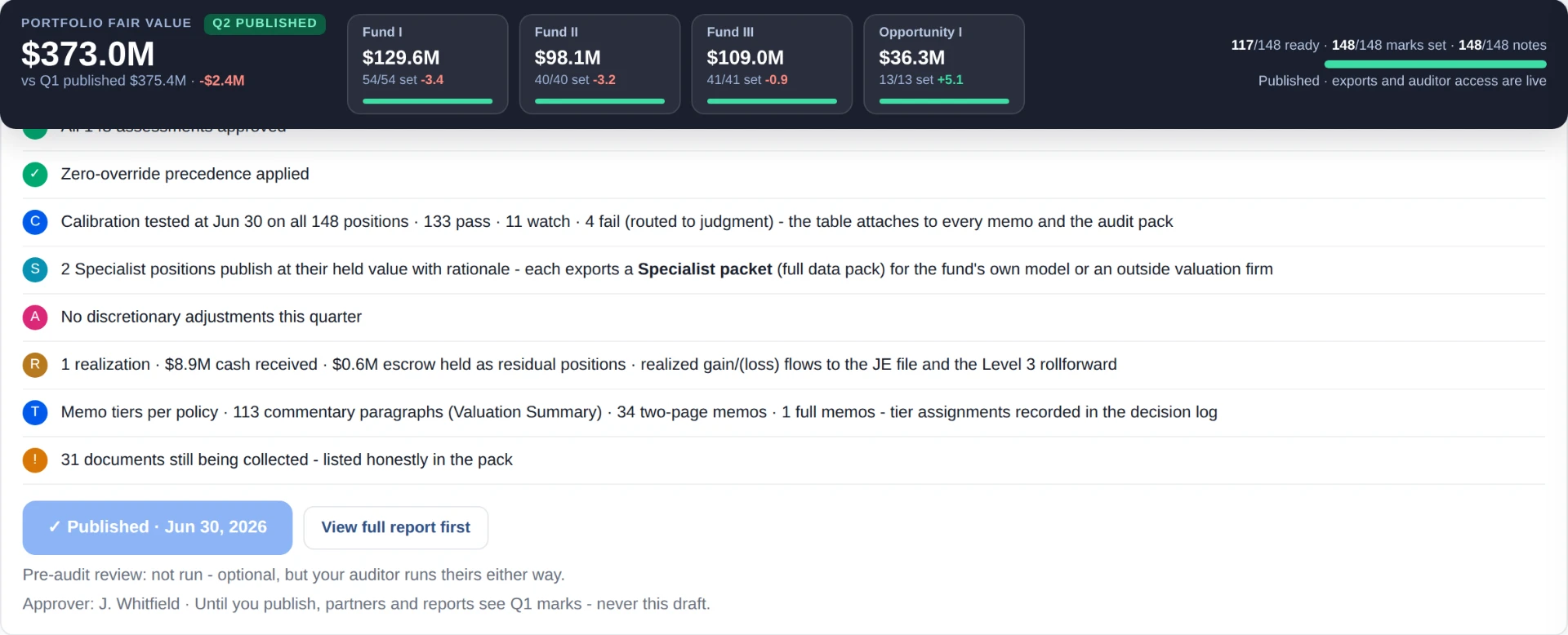
The approval card reads the whole quarter the way your auditor will: every mark against your valuation policy, calibration run on every position, the preparer never the approver, and every exception named and documented. An optional pre-audit review asks what the auditor would ask before they ask it. You stay the preparer and the approver: the software suggests, you decide, and every drafted assessment is labeled as drafted, with its prompt version, in the audit pack.
- 01
Marks set on every position, assessments approved, precedence applied.
- 02
Calibration on every position, with the table attached to every memo and the audit pack.
- 03
Realizations flow through to the journal entries and the rollforward.
- 04
Memo tiers per policy, recorded in the decision log.
Deliverables
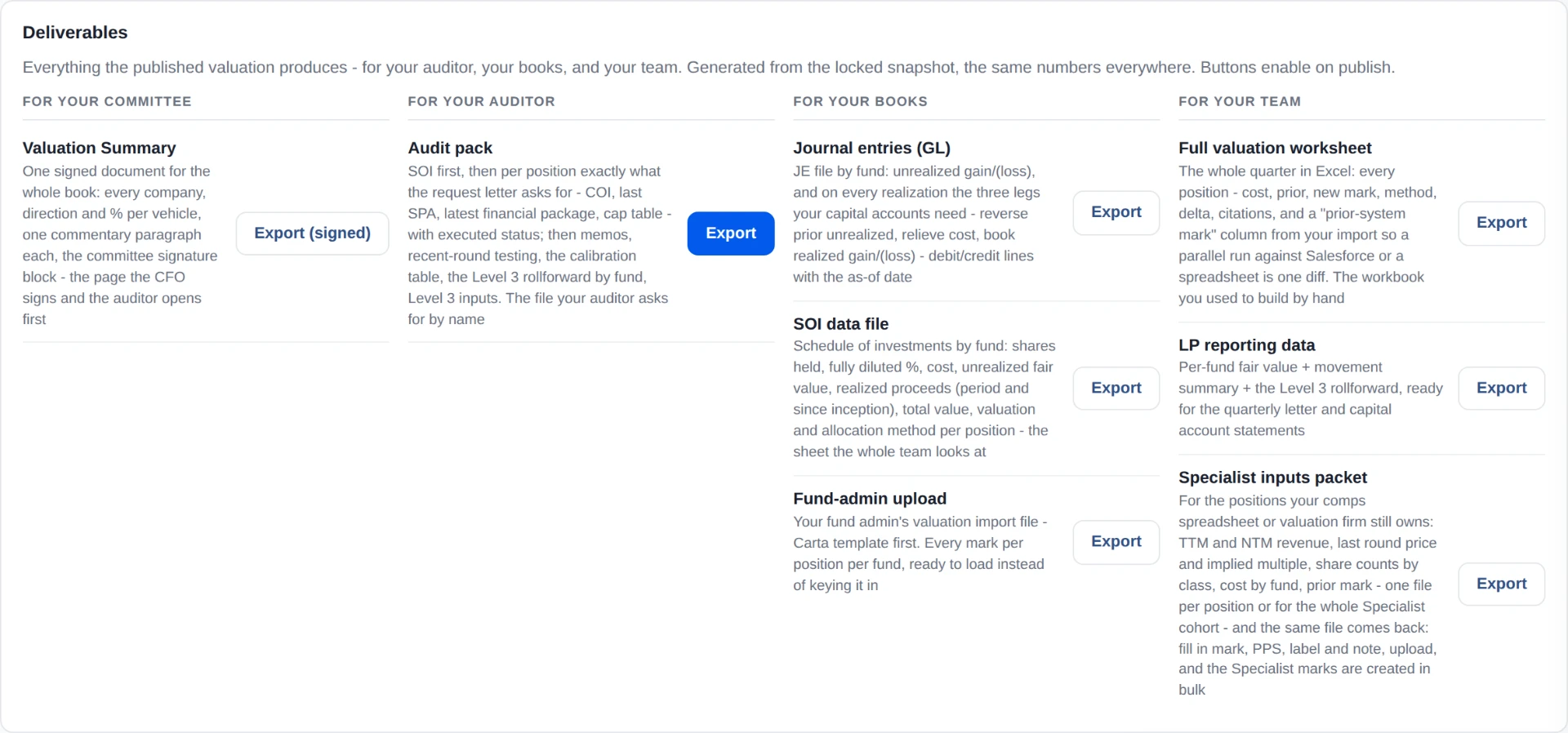
The file your auditor asks for by name.
Everything the published valuation produces, generated from the locked snapshot so the same numbers land everywhere: the signed valuation summary for your committee, the audit pack for your auditor, journal entries and the statement of investments for your books, and the full worksheet, LP reporting data and the specialist inputs packet for your team.
Your valuation, or your valuation firm's
Produce it here, or hand over the inputs.
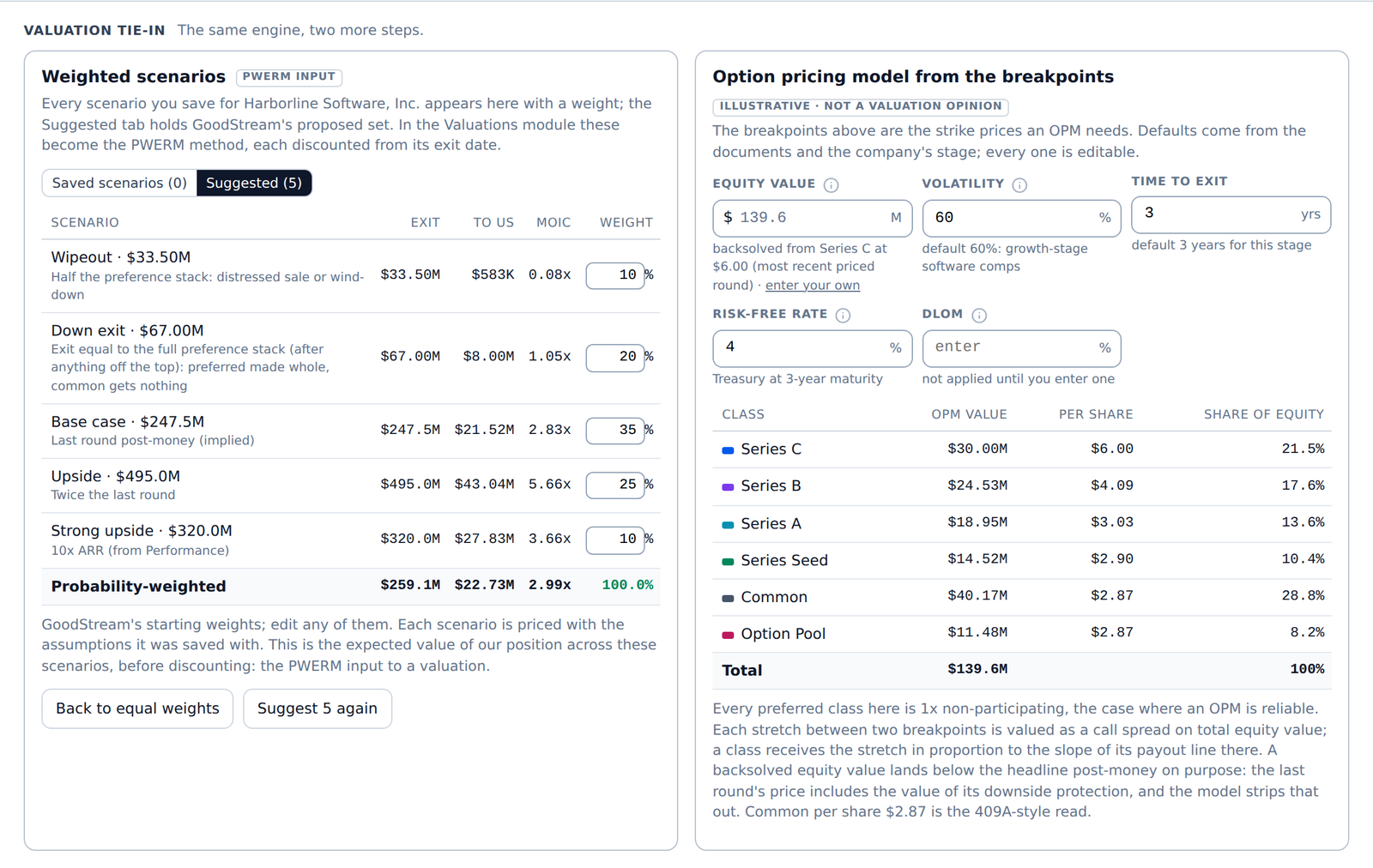
Some positions stay with your comps spreadsheet or your valuation firm, and that is fine. GoodStream hands them the inputs they would otherwise have to chase: revenue, the last round price and implied multiple, share counts by class, cost by fund, the prior mark. The same file comes back and creates the specialist marks in bulk. And because exit scenarios and valuations share one set of breakpoints, the option pricing model and the probability-weighted value start from the numbers your partners were using all year: add a probability under each exit and the weighted value is there; the breakpoints are the option pricing model's inputs.
See your own portfolio, valued and audit-ready.
Connect to your own documents. We'll run one quarter on your own portfolio, you compare our suggested marks to the ones you published, and you see the file, before you wire us a dollar. Your side of it: connect once, then answer the questions the documents cannot. Ours: the rest.
"I feel like you have crawled into my brain and turned it into software."